

What Is a Domain Name?
When building a website, one of the first terms you are likely to encounter is a domain name.
Examples include:
google.com
apple.com
yourcompany.com
These are all domain names.
A domain name is not the website itself, nor is it the server where the website is hosted.
Instead, you can think of it as a human-readable address on the Internet. It allows people to find websites and online services without having to remember a long numerical IP address.
Why Do You Need Your Own Domain?
Without your own domain, your website may use an address provided by another platform, such as:
yourcompany.someplatform.com
With your own domain, you can instead use a simpler address like:
yourcompany.com
For a business, a domain name is more than just a website address.
It can become the foundation for a consistent digital identity across websites, applications, documentation, email, and other online services.
| Use | Example |
|---|---|
| Company website | yourcompany.com |
| Application | app.yourcompany.com |
| Documentation | docs.yourcompany.com |
| Business email | [email protected] |
Why Do Domain Name Prices Vary?
Domain names do not have a single fixed price.
Some may cost only a small amount each year, while others can cost hundreds, thousands, or even much more.
There are two main reasons.
The first is the domain extension.
For example:
example.com
example.tw
example.clinic
example.ai
The endings .com, .tw, .clinic, and .ai are part of the domain name.
Different extensions can have very different registration and renewal prices.
The second is the name itself.
Short, memorable, popular, or commercially valuable names may be classified as Premium Domains and can cost significantly more than standard domain names.
If the domain you want has already been registered by someone else, you may also need to purchase it from the current owner. In that case, the price is determined by the market rather than the standard registration fee.
| Extension | Common Association |
|---|---|
.com |
One of the most widely used general-purpose domain extensions |
.tw |
Associated with Taiwan |
.clinic |
Often associated with clinics and healthcare services |
.ai |
Commonly used by AI-related companies and products |
Where Can You Buy a Domain Name?
Domain names are usually registered through a domain registrar.
Common examples include:
- Cloudflare Registrar
- Porkbun
- Namecheap
- GoDaddy
- accredited registrars for specific countries or regions
For example, .tw domain names can be registered through providers accredited by the Taiwan Network Information Center (TWNIC).
It is also important to understand that when people say they “buy” a domain, they are not usually purchasing it permanently.
Instead, they are registering the right to use that domain for a certain period of time, typically with an annual renewal.
What Is DNS?
Once you have a domain name, the Internet still needs to know where that domain should lead.
This is where the Domain Name System (DNS) comes in.
You can think of DNS as a navigation or directory system for the Internet.
When someone enters:
yourcompany.com
DNS helps determine which website or online service is associated with that domain.
DNS is not only used for websites.
Email, applications, APIs, and many other online services also rely on DNS to connect a domain name to the correct destination.
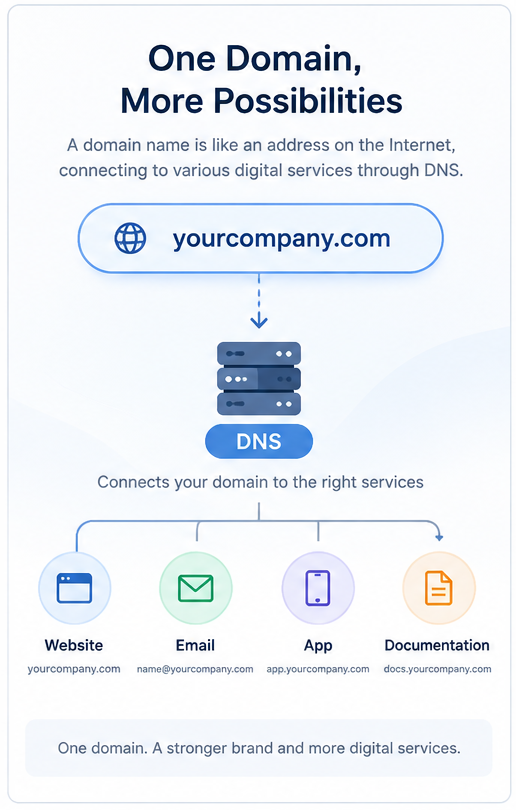
| Component | Simple Explanation |
|---|---|
| Domain | The name or address people use to reach you online |
| DNS | The system that tells the Internet where that domain should lead |
| Hosting / Server | The place where the website or service actually runs |
There Are Also All-in-One Website Platforms
If you do not want to manage domains, DNS, and hosting separately, some platforms combine several of these services in one place.
For example:
Wix / Squarespace
Suitable for company websites and personal websites, with a strong focus on building sites without writing code.
Shopify
Primarily designed for e-commerce and online stores.
Webflow
Offers greater design flexibility and sits somewhere between no-code tools and professional front-end development.
GoDaddy / Hostinger
Offer services such as domain registration, hosting, and website-building tools.
WordPress.com
Can also provide a relatively integrated way to build and manage a website.
These platforms are useful for individuals and businesses that want to launch a website quickly without managing too many technical details themselves.
Your Own Domain Can Also Be Used for Business Email
Once you own a domain, you can create email addresses such as:
[email protected]
[email protected]
[email protected]
Compared with an address such as:
a custom-domain email address can help create a more consistent and professional brand identity.
One Domain Can Have Many Subdomains
After registering:
yourcompany.com
you can create addresses such as:
app.yourcompany.com
docs.yourcompany.com
status.yourcompany.com
These are called subdomains.
In most cases, you do not need to purchase a new domain every time you create a subdomain.
This makes it possible to organize websites, applications, documentation, APIs, and other services under one main brand domain.
A Domain Name Is Also a Digital Business Asset
A website can be rebuilt.
Hosting providers can be changed.
The technologies behind a service can also change over time.
However, once a domain has been:
- remembered by customers
- indexed by search engines
- printed on business cards or marketing materials
- used for business email
- connected to apps and other services
losing that domain can have a significant impact.
Businesses should therefore manage important domain-related settings carefully, including:
- ownership of the registrar account
- automatic renewal
- registration contact information
- two-factor authentication
- other domain security settings
A domain name may look like just a web address, but for a business, it can become an important digital asset that needs to be maintained and protected over the long term.